

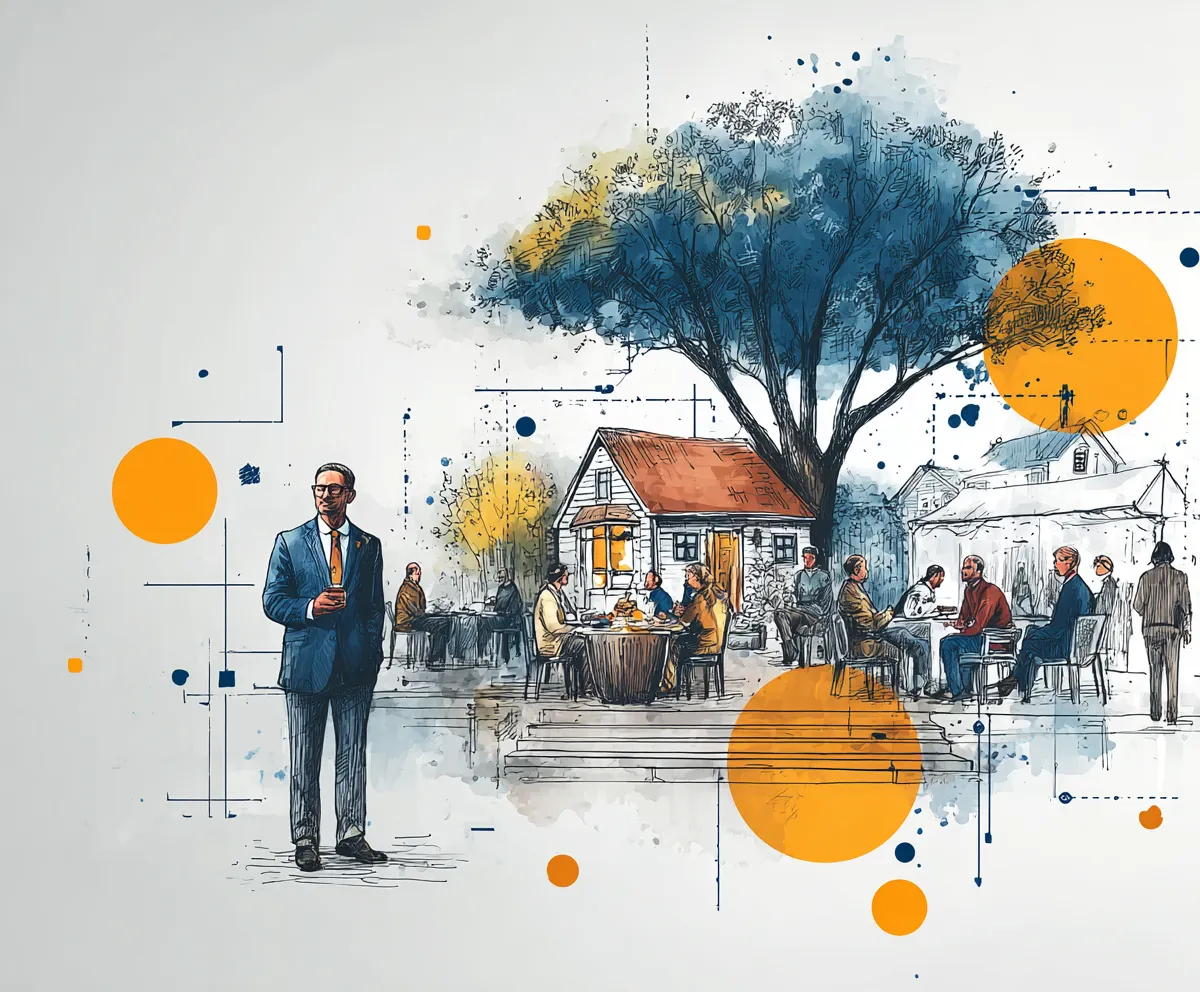
How Real Estate Agents Use Community Involvement for Lead Generation
You're working 50 hours a week, spending money on digital ads, and watching leads go cold before they convert. Meanwhile, a competing agent in your market closed three listings this year from people they met at a neighborhood cookout. You know community involvement is supposed to matter, but nobody has explained the mechanism — why it works, which activities are worth your time, and how to build something systematic instead of just showing up and hoping.
This article breaks down the data behind referral-based agent discovery, explains how community presence converts into actual business, and gives you a framework for selecting the right activities, building relationships without the transactional pressure that kills them, and tracking community-sourced business over a 12-month horizon. Community involvement is a long-game system, not a lead-generation hack — and the agents who treat it that way consistently outperform the ones chasing short-cycle tactics.
Unlock your potential with AI-powered solutions tailored to your real estate needs. Save time, grow faster, and work smarter. Schedule your discovery session now at lesix.agency/discovery.
Why Community Involvement Drives Agent Discovery
Before you invest time in any community activity, you need to understand what you're actually building. Community involvement doesn't generate leads the way a Facebook ad does — it builds the social infrastructure that makes referrals happen. Those are fundamentally different mechanisms, and confusing them produces the wrong expectations and the wrong activities.
According to the NAR 2025 Profile of Home Buyers and Sellers, 43% of buyers found their agent through a friend, neighbor, or relative. For first-time buyers, that number climbs to 49%. These aren't buyers who searched Google and landed on an agent — they asked someone they trusted, and that person named a specific agent. That trust-transfer is the mechanism community involvement builds.
The data from Zillow's 2025 Consumer Housing Trends Report adds a second dimension: 11% of buyers in 2025 already knew their agent directly from the community — up from 8% in 2024. That means combined personal and community connections account for roughly half of all agent discovery. The trend line is moving in the right direction. Agents with deliberate community presence are capturing an increasing share of buyers before those buyers even start searching.
There's one more number worth understanding: NAR's 2025 data shows that 74% of buyers interviewed only one agent. When someone in your community decides to sell or buy, a trusted personal introduction effectively closes their consideration set. You don't need to be the best-marketed agent in the market. You need to be the agent someone they trust names first.
The Referral Flywheel
The referral flywheel works in two stages. First, community presence generates direct introductions — people in your network who are ready to transact reach out because they already know you. Second, satisfied clients from those transactions fuel the next generation of referrals. According to the NAR 2025 Profile, 91% of buyers said they would definitely or probably recommend their agent, and 62% had already done so since purchasing. A single closed transaction from a community introduction generates referral capacity for years. The inputs compound; the outputs don't require ongoing spend.
Event Selection: High-ROI Activities vs. Time Sinks
Not all community involvement is equal. The question isn't whether to show up — it's where to show up and how to structure your presence so it actually moves toward business. Most agents who say community involvement doesn't work are attending the wrong activities, or attending the right ones without any system behind their participation.
High-ROI community activities share three characteristics: they repeat (giving you multiple interactions with the same people over time), they attract your target client profile (not just anyone in the area), and they give you a natural reason to be there that isn't real estate. When your presence is driven by genuine participation rather than prospecting, the social dynamic changes. People talk to you differently, remember you differently, and introduce you differently.
Activities Worth Your Time
Neighborhood-specific events are the highest-leverage entry point if you're focused on a defined geographic farm. A barbecue, a holiday gathering, or a community cleanup gives you repeated contact with the exact pool of people most likely to sell or refer you. According to Realtor.com's event hosting framework, events like these create positive repeated interactions — the compounding effect that converts casual recognition into genuine trust.
School and youth organization involvement works for agents targeting families. If your ideal client has kids in the local school system, being present and contributing to that community positions you as a neighbor first and an agent second. PTA boards, booster clubs, and sports leagues all fit this category.
Allied professional networks — mortgage brokers, financial planners, estate attorneys, contractors — are a different kind of community involvement but often produce faster business. These relationships generate agent-to-agent and professional-to-agent referrals. NAR's referral-building framework identifies specialized referral relationships with allied professionals as a consistent source of business, separate from client-facing community presence.
Activities to Deprioritize
Generic networking events — chamber of commerce mixers, real estate investor meetups, broad business networking groups — have low ROI for most residential agents. The attendee profile doesn't match your target client, and the transactional energy of those environments works against the trust-building dynamic you're trying to create. Attend these only if you have a specific referral relationship to maintain, not as a primary community strategy.
Building Relationships Without the Transactional Pressure That Kills Them
The fastest way to make community involvement ineffective is to show up visibly as an agent rather than as a neighbor. When people sense they're being prospected, they disengage. The conversion you're trying to build depends on relationships that feel genuine — and they need to actually be genuine, not performed.
The value-first principle is straightforward in concept and frequently violated in execution. When you're at a community event, your job is to be useful and present — not to collect contact information or drop business cards. Help set up, stay late, volunteer for the unglamorous tasks. Introduce people to each other. Know enough about your neighborhood to be a resource for questions that have nothing to do with real estate. The people who remember you most clearly are the ones who saw you doing something that cost you time and gave them value.
NAR's referral-building guidance frames this as focusing on meaningful connections over transactional networking. That's correct, but it requires a specific mindset shift: you're not at this event to generate leads. You're at this event to build the social infrastructure that will generate leads over the next 12-24 months. If that time horizon feels too long, community involvement probably isn't the right primary channel for your current situation.
The Follow-Up Window
After any community event — whether you hosted it or simply attended — there's a narrow window where a well-timed follow-up reinforces the connection without feeling like a sales move. Realtor.com's event hosting framework recommends prompt thank-you follow-up and inviting people to the next useful activity rather than pitching your services. The goal of the follow-up is to extend the relationship, not to close it. An invitation to the next neighborhood gathering, or a relevant community update, accomplishes this without pressure.
Record specific conversation details in your CRM immediately after each event — what someone mentioned about their home, their family, their timeline. When you reach out three months later with something relevant to what they told you, the relationship quality signals clearly that you were paying attention. That's the kind of behavior people describe when they refer you. They're not just recommending a skilled agent; they're vouching for the kind of person you are.
Building Your Community Involvement System
Community involvement without a system produces inconsistent results and slow burnout. You show up for a few months, don't see immediate business, and conclude it doesn't work. What actually didn't work was the absence of structure — no tracking, no intentional event selection, no follow-up discipline.
A functional community involvement system has four components: a defined activity calendar, a contact capture process, a CRM follow-up workflow, and a tracking method for community-sourced business. Each component is simple. Together they convert random presence into a repeatable lead source.
Activity Calendar
Commit to a fixed number of community touchpoints per month — two to four, depending on your available time. Map these out quarterly so you're not making ad hoc decisions about where to show up. Mix hosted events (where you control the environment and get registration data) with attended events (where your presence is contribution, not production). Schedule these alongside your other marketing activities so community involvement doesn't expand indefinitely into the rest of your week.
The 90-Minute Marketing Department is built around this kind of structure — dedicated, time-bounded marketing disciplines that produce compounding results without consuming your entire week. Community involvement fits this model: defined inputs, consistent execution, measured outputs over a 12-month horizon.
Contact Capture Without Pressure
At events you host, contact capture is natural — event registration collects names and emails before anyone arrives. Realtor.com's framework recommends using registration forms and social media sign-ups to build your list before the event, which means the follow-up permission is already established.
At events you attend, don't force contact capture. Exchange information only when it's natural — when someone asks for your card, or when the conversation reaches a point where staying in touch is an obvious next step. Forced business card exchanges at community events signal exactly the transactional energy you're trying to avoid.
CRM Discipline
Every meaningful community interaction gets logged in your CRM within 24 hours. Include the event, the date, what you discussed, and any relevant context about their real estate situation. Tag contacts by how you met them — neighborhood event, school involvement, allied professional — so you can segment and track community-sourced contacts separately from other leads.
Set reminder tasks for follow-up at 30, 90, and 180 days. The content of each follow-up should reference something specific from your conversation or something relevant to their situation. Generic check-in messages dilute the relationship quality you've built in person.
Tracking Community-Sourced Business
Track every transaction and referral that traces back to community involvement. You need to know: how many contacts entered your pipeline from community activities, what percentage converted to consultations, and what percentage closed. This data answers the ROI question over time and helps you identify which activities produce the most productive contacts.
Expect a 12-18 month lag between initial community investment and first measurable business. The Zillow 2024 Consumer Housing Trends Report shows community-based agent discovery increasing year-over-year, which means agents who started building this presence 12-18 months ago are now seeing it pay off. The agents who start now will see the same results by 2027-2028. The constraint isn't the method — it's the patience to run it long enough to measure it honestly.
When Community Involvement Makes Sense — and When It Doesn't
Community involvement is not the right primary lead source for every agent in every situation. It's a long-game channel that works best when you have a defined geographic focus, a client profile that maps to a specific community, and the capacity to sustain consistent presence for at least 12 months before expecting measurable returns.
It makes the most sense when you're geo-farming a specific neighborhood or zip code, when your ideal clients are families or established residents with community ties, or when your market is relationship-driven and buyers already rely heavily on personal referrals (which the NAR referral data suggests is most markets). It also works well as a complement to direct mail or other awareness-building channels that create name recognition before the in-person interaction.
Community involvement is less effective as a primary channel when you need short-cycle leads immediately, when your target clients don't have meaningful community ties, or when your geographic focus is too broad to sustain concentrated presence in any one area. In those cases, other lead sources — paid digital, open houses, agent-to-agent referral networks — produce faster results at the cost of lower conversion rates and higher ongoing spend.
The honest framing: community involvement is the highest-trust, lowest-cost, slowest-to-produce lead source available to residential agents. According to NAR, 18% of all Realtors' business comes through referrals from past consumers and clients — and community involvement is the system that builds the relationships those referrals come from. If you have a 12-month horizon and a defined geography, it belongs in your lead generation mix. If you need business in 60 days, it's not the right tool for that problem.
Conclusion: Build the Infrastructure, Then Work It
Community involvement works because it builds the social infrastructure that referrals travel through. Forty-three percent of buyers find their agent through someone they know. Seventy-four percent interview only one agent. When you are the name someone trusted names first, the sale is largely complete before you've had a single conversation about real estate. That outcome doesn't come from a campaign — it comes from sustained, genuine presence in the right community over the right time horizon.
The system is straightforward: select high-ROI activities that reach your target client profile, show up as a neighbor rather than an agent, capture contacts without pressure, follow up with CRM discipline, and track community-sourced business so you can measure what's working. Run that system for 12-18 months before drawing conclusions. The agents who build this infrastructure and work it consistently are the ones who find, years later, that most of their business comes from people who already knew them.
Ready to take your real estate success to the next level? Schedule your discovery session today at lesix.agency/discovery. Stay ahead with tips and insights—subscribe to our newsletter at lesix.agency/newsletter.


